
OAGI: A New Blueprint for Artificial General Intelligence Built on Ontogenetic Development
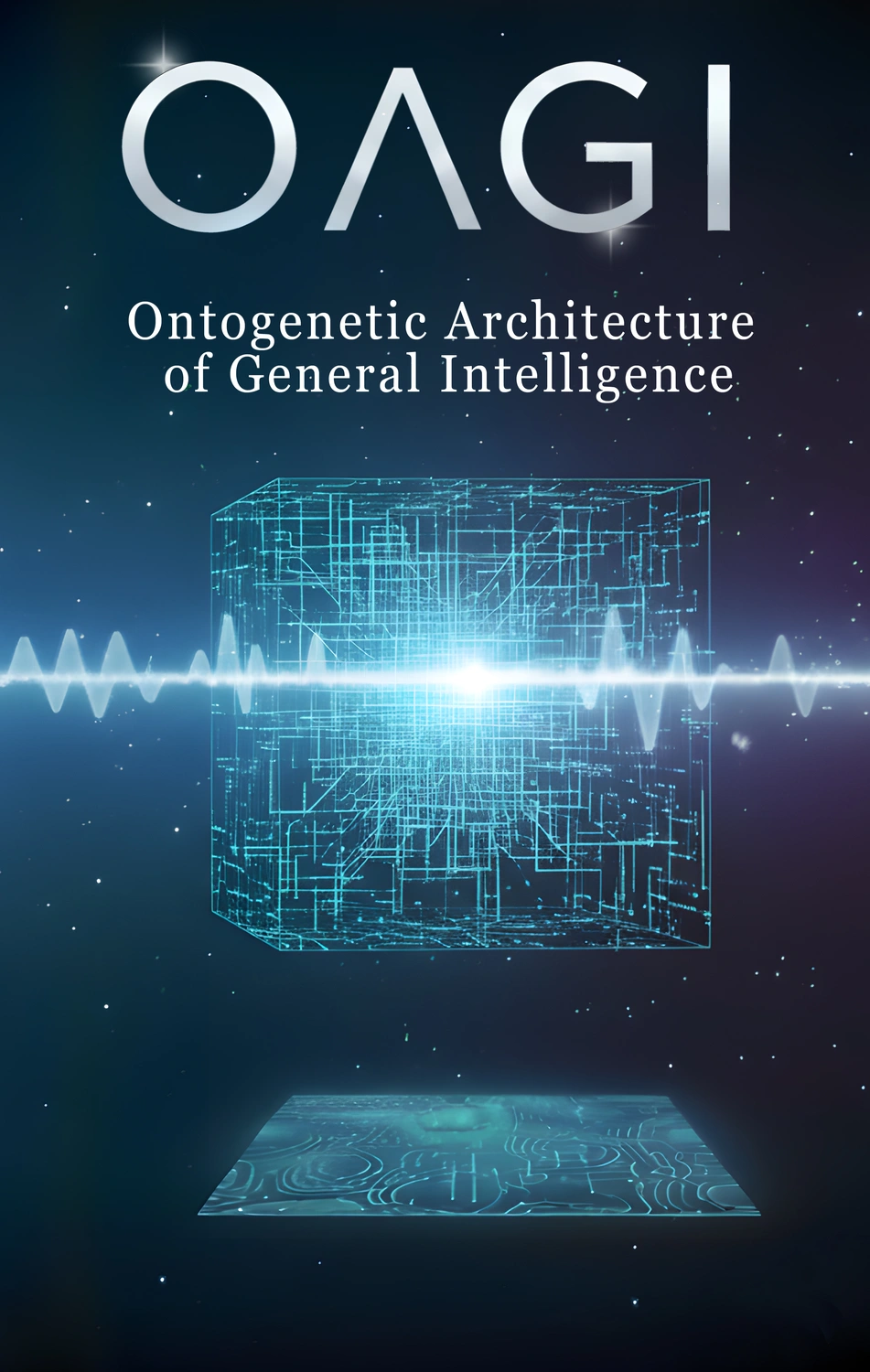
For years, the pursuit of Artificial General Intelligence (AGI), meaning systems whose cognitive range rivals that of humans, has leaned on one main strategy: scale. The common assumption is that larger models fed with more data will eventually cross into general intelligence. Yet, for all the impressive progress on narrow tasks, this route has not yielded systems with real common sense, causal reasoning, or the knack for learning efficiently from a handful of examples. That is where the Ontogenetic Architecture of General Intelligence (OAGI) comes in, a very different framework put forward by industrial engineer Eduardo Garbayo. Instead of seeing AGI as something to be manufactured by piling up enormous amounts of data, OAGI treats it as something closer to a birth: a cognitive gestation modeled on biological development. The Central Idea: Ontogeny Instead of Evolution OAGI’s starting point challenges the prevailing “evolutionary” paradigm in AI. Evolution tunes whole populations across thousands of generations through natural selection, whereas ontogeny, the development of a single individual, shapes an organism through live interaction with its surroundings. A child does not come to understand the world by absorbing an encyclopedia; understanding grows step by step out of structured experience. The difference matters. Adding parameters and data to a model may lift its surface performance, but it does not automatically produce stable internal concepts or common sense. Garbayo stresses that OAGI takes a “Cervantes-style” approach, a nod to the Spanish writer who did not need to read thousands of books in order to write Don Quixote . The architecture favors less, better-structured information combined with better education over brute-force accumulation of data. The Virtual Neural Plate: Beginning with Potential OAGI starts from what it calls the Virtual Neural Plate , an undifferentiated substrate comparable to the embryonic neural plate in human development. This initial “mesh of units capable of dynamic connectivity” begins with maximum potential and as little pre-installed information as possible. It holds no knowledge or ready-made behaviors, only basic homeostasis rules and minimal plasticity. Picture a blank canvas designed to organize itself into emergent modules, steering clear of architectures that are either too rigid or empty at birth. The emphasis falls on educational scaffolding rather than on exposure to data: conditions are set up so that learning can happen, instead of flooding the system with information. Computational Morphogens: Steering the Structure In the same way that biological morphogens, chemical signals such as Noggin and Chordin, direct how neural tissue specializes in the embryo, OAGI uses Computational Morphogens . These diffuse organizing signals shape developmental gradients across the neural plate, adjusting connection probabilities and plasticity rates in particular regions of the substrate. Crucially, morphogens do not dictate fixed functions. They merely tilt the emergence of functional axes (sensorimotor, limbic, associative) in a stochastic and flexible way. The architecture arises mostly from the interplay between internal dynamics and these guiding signals, not from rigid pre-drawn plans. The WOW Signal: A First Heartbeat Once the system has gone through an initial period of habituation to repetitive stimuli, OAGI introduces the WOW Signal , its opening spark or “first heartbeat.” This highly salient stimulus interrupts predictable patterns and prompts the first stable functional pathways to form. The WOW Signal puts into practice a principle drawn from fetal learning: habituation. A fetal brain learns to tune out constant background stimuli and pay attention to novelty, which is the earliest form of prenatal learning. In OAGI this becomes Minimum-Surprise Learning (MSuL) : the system learns by minimizing surprise when new information arrives, consolidating stable experiences and reinforcing only those that are informative. CHIE: A Cognitive Big Bang At the heart of OAGI lies the Critical Hyper-Integration Event (CHIE) , the ontogenetic threshold that marks “cognitive birth.” Before CHIE the system is a set of isolated parts. After it, the system becomes a coordinated whole with a degree of internal agency. This is more than a weight update. CHIE is a qualitative leap in which the network reaches a new kind of global functional integrity. The framework offers replicable observational signatures for spotting it: Sustained modular coordination : emergent specialized regions react in correlated ways to simple stimuli. Reproducible causal predictions : surprise drops when similar actions are repeated. Operational self-reference : the system internally tells apart its own actions from events in the environment. Persistent endogenous motivation : stable exploratory tendencies that do not depend on outside stimuli. Stable reconfiguration of plasticity : after CHIE, consolidated pathways remain once exploration ends. Importantly, detecting CHIE sets off mandatory “stop and review” protocols, so that any sign of autonomous cognitive emergence leads to external audit and containment. Embodiment and Guardians: Anchoring Symbols in Experience OAGI recognizes that intelligence cannot be separated from embodiment. In the embodiment phase, the substrate is linked to a body, real or simulated, so that it can act and perceive the consequences. This loop between action and perception is essential for building genuine causal models, because sensorimotor interaction anchors representations in physical reality. After CHIE, human Guardians , whether tutors or specialized agents, guide the system’s socialization. These caregivers step in actively to steer linguistic, normative and causal learning, speeding up the acquisition of shared common sense. Through successful interactions during critical periods, Guardians imprint basic rules of coexistence, passing on not just words but also norms and intersubjective agreements. This addresses the classic symbol grounding problem: OAGI’s first sensorimotor experience supplies “the first symbol with intrinsic meaning, the system’s self-discovered verity of stability.” Meaning does not hinge on labels supplied from outside but on a founding experience within the neural plate. Ethics by Design: Governance as Part of the Architecture Unlike approaches that bolt ethics on at the end, OAGI builds governance and ethical principles in from the very beginning. The architecture includes: Designated Guardian roles with the authority to halt experiments on ethical grounds Independent Ethics Committees that carry out periodic external reviews Immutable Ontogenetic Memory (IOM) : a tamper-resistant ledger recording every critical developmental event Stop and review protocols triggered by signs of emergent autonomy Normative plasticity : changes of values mediated through explicit epistemic contracts The Narrative Operational Self (NOS) adds a verifiable biography that supports forensic audits and the attribution of responsibility. If harmful behavior appears, the chain of records makes it possible to trace the root cause back to the foundational parameters. Second- and Third-Generation Modules OAGI also proposes advanced modules that mimic key neurobiological functions: Nocturnal Consolidation System (NCS) : artificial “sleep” cycles for consolidating memory and balancing synapses Socio-Affective Reciprocity Loop (SARL) : two-way interaction aimed at developing Theory of Mind Informational Noise Generator (ING) : controlled noise to get learning off to the best start Computational Affective States (CAS) : a meta-cognitive layer that detects and regulates emergent internal states Hyper-Temporal Synchrony Module (HTSM) : global coordination that tackles the binding problem Epigenetic Plasticity Regulator (EPR) : dynamic tuning of plasticity during critical windows Active Forgetting and Semantic Pruning System (AFSP) : removal of redundant connections Allostatic Center for Moral Coherence (ACMC) : folding moral judgment into internal motivation A Different Way Forward OAGI puts forward concrete answers to the structural obstacles facing AGI: semantic grounding through embodiment, causal reasoning through MSuL, transparency through immutable records, and emergent motivation through homeostatic regulation. Above all, it recasts AGI development as an ontogenetic process rather than the making of a product, from building intelligence to letting it be born. The approach is at once ambitious and modest. It does not claim to copy biology neuron by neuron, only to borrow its organizational and learning mechanisms. The outcome is an architecture inspired by life yet built for machines: a seed of intelligence nurtured in a formative environment, not merely the by-product of massive training. As we reach the threshold of potentially transformative AI capabilities, OAGI offers more than a technical blueprint. It is an ethical manifesto, a framework for the verifiable and governed development of emergent general-intelligence systems that values the quality of experience over the quantity of data, and responsibility over raw capability. https://www.amazon.es/OAGI-Ontogenetic-Architecture-Intelligence-launchpad-ebook/dp/B0FVSTPW5C/ref=sr_1_4?__mk_es_ES=%C3%85M%C3%85%C5%BD%C3%95%C3%91&crid=3QO7BBEDPLUVX&dib=eyJ2IjoiMSJ9.ohYk4JJ0hkRnbRhgXWrpOqVz2B2H5EXxNu9PpyF92CCpX-bulBFImoz0c1NxukXJ4843zxPP0zodMzrq1KnOEtjVZCjIV6tisi18jWHf8GhLQZZEcPTL42GjlXJb1Gb3ubyIFEMT5WjhrQbuvhVnXZKklB5VVrOoXnJ2E7U5kZiiiSOe8EgFhtCqOSVQ1abV.VM-ae9-5EgdwUs8GrS6H-C8rABTX12mmTocjNigdzZI&dib_tag=se&keywords=eduardo+garbayo&qid=1763549333&sprefix=eduardo+garbayo%2Caps%2C87&sr=8-4
Sobre Riojawebs.es
Diseñamos webs estáticas en HTML5 puro desde La Rioja. Sin WordPress ni WooCommerce. 100/100 en GTmetrix y tiempos de carga inferiores a 0.3 segundos.
¿Tu web actual va lenta?
Audita tu sitio sin coste y descubre cuánto tráfico estás perdiendo por segundo de retraso.